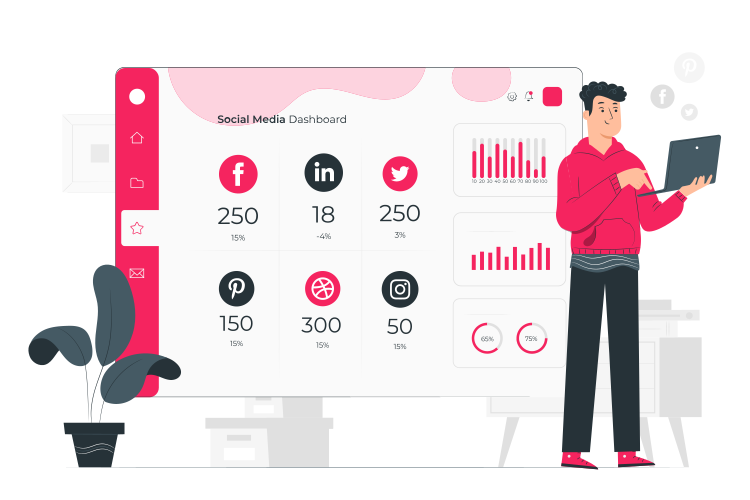

If you have ever opened your Instagram insights or Facebook page analytics and felt immediately lost, you are in good company. Social media analytics can be genuinely confusing for business owners who have not spent time with data platforms before, and the sheer volume of numbers available across multiple platforms can make even a simple performance review feel like hard work.
The good news is that you do not need to understand every metric to get useful information from your analytics. You need to understand a handful of core concepts, know where to find the key data on each platform, and develop a simple routine for reviewing your numbers regularly. This guide covers all three.
Why analytics matter for your business
Social media analytics exist to tell you whether your content is working. Without them, you are essentially posting into a void and hoping for the best. With even a basic understanding of your analytics, you can see which posts are resonating with your audience and which are being ignored, which platforms are sending traffic to your website and which are not, and whether your overall presence is growing or stagnating.
Analytics also help you move away from decisions based on gut feeling and towards decisions based on evidence. Instead of posting what you think your audience wants to see, you can post more of what the data shows they actually engage with. This shift from intuition to evidence is one of the most significant improvements any business can make to its social media approach, and it does not require specialist skills or expensive tools.
Where to find your analytics
Every major platform provides built-in analytics at no cost. On Instagram, you will find your insights by tapping your profile picture and selecting Professional Dashboard, or by opening the Insights section directly from a business account. Facebook page analytics are accessible via the Insights tab on your page. LinkedIn provides analytics from the Analytics section of your company page, and TikTok for Business offers a similar dashboard for business accounts.
For a more consolidated view across multiple platforms, tools like Google Analytics are worth exploring, particularly for tracking how social media channels are contributing to your website traffic. Ofcom's Online Nation report provides useful context on how UK audiences use different social platforms, which can inform which analytics you prioritise depending on where your target customers are most active.
The key numbers to focus on first
For businesses new to analytics, the most useful starting point is a small set of numbers that give a clear picture of whether your content is reaching people and whether they are responding to it. Reach is the number of unique accounts that have seen your content in a given period, and it is the clearest indicator of how broadly your content is being distributed. Impressions shows how many times content was displayed in total, which is always higher than reach because the same person can see your content more than once.
Engagement rate is arguably the most useful single metric for most small businesses. It shows the proportion of people who saw your content and took some action in response, such as liking, commenting, sharing, or saving it. A high engagement rate indicates that your content is genuinely interesting to your audience, not just appearing in their feed. Follower growth, tracked over time rather than as a snapshot, shows whether your audience is expanding at a healthy rate.
Reading data without a marketing background
The most common mistake beginners make with analytics is trying to draw conclusions from individual posts rather than from trends across time. A single post that performs poorly does not mean your strategy is failing. A single post that does exceptionally well does not mean you have cracked the formula. What matters is the pattern across dozens of posts over weeks and months. Look for consistent themes in the content that performs well, track whether your average reach and engagement are improving over time, and focus on the direction of travel rather than individual data points. A good social media management service will present this data in a structured way that makes trends easy to identify.
It also helps to review your analytics at a consistent time each month rather than checking them sporadically. A regular monthly review allows you to compare the same period across successive months and spot meaningful changes in your performance. Keep a simple record of your key metrics each month so that you can look back over several months of data and identify patterns that would not be visible in any single snapshot.
When to consider professional support
Many business owners reach a point where they are spending more time trying to understand their analytics than they are producing content or running the business. If your analytics are creating more questions than answers, or if you feel you are not getting actionable information from the data you have, it may be worth exploring social media packages that include structured performance reporting as a standard component of the service. Having someone interpret the data and translate it into clear recommendations can save a significant amount of time and make your social media strategy considerably sharper.
Conclusion
You do not need to become a data analyst to benefit from social media analytics. You need to know where to find your key numbers, understand what a small set of core metrics actually mean, and build a habit of reviewing them regularly. With that foundation in place, your social media decisions will be better informed and your investment in the channel will be easier to justify and improve over time.
Want analytics-backed social media management without the complexity? 99social provides every client with clear monthly performance reports so you always know exactly how your social media is performing.
Do I need to pay for analytics tools or are the free ones good enough?
For most small businesses, the free native analytics provided by each social media platform are sufficient for understanding performance at the level needed to make good content decisions. Instagram Insights, Facebook Page Insights, LinkedIn Analytics, and TikTok's business dashboard all provide reach, engagement, and audience data at no cost. Paid tools add value if you need cross-platform reporting in one place, deeper competitor analysis, or scheduling integration, but they are not necessary for effective analytics at the small business level.
How long should I wait before drawing conclusions from my social media analytics?
A minimum of three months of consistent posting is generally needed before drawing meaningful conclusions from social media analytics. Early data is often too variable and too sparse to identify reliable patterns. By the three-month point, you should have enough posts and enough audience interactions to see which content types and topics perform consistently well, how your reach and engagement are trending, and whether your overall strategy is moving in the right direction.
What does reach mean in social media analytics?
Reach refers to the number of unique individual accounts that have seen your content during a specific period. If your post was seen by five hundred different people, its reach is five hundred. This is different from impressions, which counts the total number of times your content was displayed and will be higher than reach if some people saw the same post more than once. Reach is generally the more useful of the two metrics for understanding how widely your content is being distributed.
How is engagement rate calculated on social media?
Engagement rate is typically calculated by dividing the total number of engagements on a post, which usually includes likes, comments, shares, and saves, by the reach of that post, then multiplying by one hundred to express it as a percentage. Some platforms and tools calculate engagement rate differently, using follower count as the denominator rather than reach, so it is worth checking the definition used by any tool you rely on. As a general guide, an engagement rate of between one and five per cent is considered healthy for most small business accounts.
Can social media analytics tell me who my audience is?
Yes, most platforms provide audience demographic data including age ranges, gender breakdown, and geographic location of your followers or the people who engage with your content. Instagram, Facebook, and LinkedIn in particular offer reasonably detailed audience insights. This information is valuable for confirming whether your content is reaching your intended target audience or attracting a different demographic than you expected, and it can inform decisions about content style, tone, posting times, and platform focus.
Ready to grow your social presence?
We handle your social media so you don't have to. From just £99 per month, we create content, schedule posts, and grow your audience, letting you focus on running your business.