
Tracking social media growth is about far more than watching your follower count tick upward. Real growth on social media is multidimensional, and the businesses that progress most consistently are those that take a structured approach to monitoring their performance across a range of meaningful indicators. Without tracking, it is impossible to know whether your efforts are moving you in the right direction.
For UK businesses of all sizes, developing a clear system for tracking social media growth is one of the most valuable investments you can make in your digital marketing. It removes the guesswork, helps you allocate your time and budget more effectively, and gives you the evidence you need to make confident decisions about your strategy. This guide walks you through the key methods and tools involved.
What does social media growth actually mean?
Many businesses equate social media growth with follower count, and while audience size is certainly one component, it is a limited view of what growth actually means in practice. True social media growth encompasses a range of factors: the size and quality of your audience, the level of engagement your content generates, the amount of traffic your social channels drive to your website, your brand visibility in your market, and ultimately the contribution your social activity makes to your commercial goals.
A business can grow its follower count while its engagement rate falls, its reach declines, and its website referral traffic stagnates. Conversely, a business with a modest and slowly growing audience might be seeing significant increases in engagement, website visits, and enquiries. The latter is almost always the more commercially valuable position. When setting up a tracking system, it is important to capture growth across all of these dimensions rather than fixating on a single figure.
The key metrics to monitor
The most important growth metrics for most businesses fall into a few broad categories. Audience growth rate, which measures the percentage change in your follower count over a given period, is more useful than raw follower numbers because it shows momentum. Engagement rate tracks the proportion of your audience that actively responds to your content, and an upward trend here signals that your content is improving in quality and relevance.
Reach and impressions show whether your content is spreading to new audiences over time. Website referral traffic from social media, visible in Google Analytics, tells you whether your social presence is successfully driving people to your site. For businesses with commercial goals, tracking leads or conversions attributed to social media activity provides the clearest evidence of growth in terms that matter directly to the bottom line.
Setting up your tracking system
The first step in building a tracking system is deciding which metrics you will monitor and at what frequency. Start by connecting your social platforms to whatever analytics tools you plan to use, and make sure Google Analytics is set up with proper source tracking for any links you share. Most businesses find it useful to track a core set of three to five metrics consistently, rather than attempting to monitor everything and getting overwhelmed by data.
Create a simple tracking document, whether that is a spreadsheet or a dashboard within a tool like Hootsuite or Sprout Social, where you record your key metrics at regular intervals. Monthly snapshots work well for most businesses, though some metrics such as engagement rates benefit from weekly monitoring. The act of recording data consistently, even in a basic format, makes it far easier to identify trends and spot problems before they become entrenched.
Native tools versus third-party platforms
Every major social platform provides its own analytics, and for many small businesses these free native tools are sufficient. Instagram Insights, LinkedIn Analytics, Facebook Business Suite, and TikTok Analytics all offer audience demographics, post performance data, and growth metrics. The limitation of native tools is that they are siloed within each platform, making it difficult to get a cross-channel view of your overall social media performance.
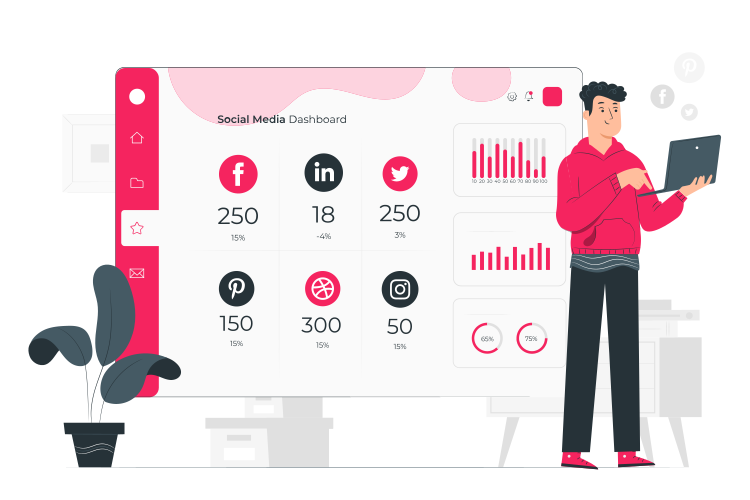
Third-party tools bridge this gap by aggregating data from multiple platforms into a single dashboard. Tools such as Hootsuite, Buffer, Sprout Social, and Later all offer various levels of analytics functionality alongside scheduling and management features. Good social media management typically includes access to consolidated reporting so nothing slips through the gaps.
Using growth data to inform your strategy
The purpose of tracking social media growth is not simply to collect data but to use that data to make better decisions. When you notice that a particular type of content consistently outperforms others in terms of reach or engagement, that is a signal to create more of it. When your follower growth rate slows down, that might indicate a need to refresh your content mix, experiment with new formats, or invest in targeted paid promotion.
Regular data reviews also help you understand seasonality in your social media performance, which can inform your content planning. Many businesses find that certain topics, campaigns, or content styles perform significantly better at specific times of year. Tracking your data over twelve months or more allows these patterns to emerge and gives you the insight to plan ahead rather than react in the moment.
Conclusion
Tracking social media growth effectively requires a clear system, a consistent set of metrics, and a commitment to reviewing the data regularly. The businesses that improve their social media performance most reliably are those that treat tracking as an ongoing discipline rather than an occasional check-in.
Start simple, be consistent, and allow your data to guide your strategy. Over time, you will develop a precise understanding of what works for your business and build the kind of social media presence that delivers sustainable, compounding growth.
Need help tracking and growing your business's social media presence? At 99social, we take the complexity out of social media for UK businesses, managing your channels and reporting on what matters. Get in touch today to learn more.
How often should I check my social media growth metrics?
Most businesses benefit from a monthly review of key growth metrics, with some metrics such as engagement rate and post performance worth checking weekly. Daily monitoring is generally only necessary during paid campaigns or time-sensitive activity. The most important thing is consistency: reviewing your data on the same schedule and against the same benchmarks over time is what allows meaningful trends to emerge.
What is a good social media growth rate?
A healthy audience growth rate varies depending on your starting point, your industry, and your level of activity. For most small and medium-sized businesses, a consistent monthly growth rate of 2 to 5% is considered solid. Rapid growth is possible during campaigns or viral moments, but sustainable and consistent growth over time is a more reliable indicator of a healthy strategy than occasional spikes.
Do I need paid tools to track social media growth?
Not necessarily. The free native analytics tools provided by each platform offer a great deal of useful data, and Google Analytics is also free. For businesses active on multiple platforms who want a single consolidated view, a paid tool can save a significant amount of time and provide richer reporting. However, a simple spreadsheet tracking your core metrics monthly is often enough to get started and can be just as effective.
What should I do if my social media growth has stalled?
A growth plateau is common and usually signals that it is time to reassess your content strategy. Look at what content has performed best in the past and consider whether you have drifted away from that approach. Experimenting with new formats, posting at different times, engaging more actively with your community, or investing in targeted paid promotion are all worth considering. A fresh competitive analysis can also reveal new approaches that others in your industry are using successfully.
Can I track social media growth across multiple platforms in one place?
Yes. Third-party tools such as Hootsuite, Sprout Social, Later, and Buffer all allow you to connect multiple social media accounts and view growth data across platforms in a single dashboard. Some tools also allow you to generate custom reports that pull together data from all your channels, making it much easier to monitor your overall social media performance without switching between individual platform analytics tools.
Ready to grow your social presence?
We handle your social media so you don't have to. From just £99 per month, we create content, schedule posts, and grow your audience, letting you focus on running your business.