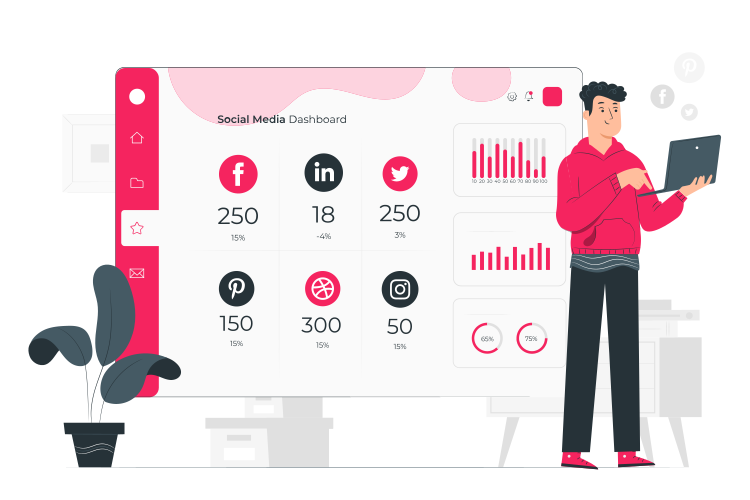

Return on investment is one of the most searched phrases in social media marketing, and also one of the most misunderstood. Many small business owners assume that measuring social media ROI requires a background in analytics, a stack of specialist tools, or hours of data work each week. In practice, it does not. With a few straightforward methods and a clear idea of what you are actually trying to achieve, any business owner can build a useful picture of whether their social media activity is paying off.
This guide strips the complexity away and focuses on what genuinely matters: understanding what your social media is doing for your business in terms you can act on.
Start by defining what return means for you
Before measuring anything, it is worth being specific about what a return on social media investment actually looks like for your business. For some businesses, the most meaningful return is inbound enquiries. For others, it is increased footfall to a physical location, more traffic to a website, or simply greater brand awareness among a local audience. The mistake most business owners make is trying to measure everything at once, which tends to produce a lot of data and very few useful conclusions.
Choose one or two outcomes that matter most to your business right now and treat those as your definition of ROI. Everything else is secondary. When you review your social media performance, the first question should always be whether those specific outcomes are improving, not whether every available metric is moving in the right direction.
The simplest way to track whether social media is driving results
The most accessible tracking method for small businesses is also one of the most reliable: asking new customers or enquirers how they found you. This is not glamorous, but it works. If a consistent proportion of your new business mentions social media as the way they first came across you, that is meaningful evidence of return that requires no tools at all.
For businesses with a website, tracking the volume of visits arriving from social media channels is straightforward using free tools like Google Analytics. If you notice that weeks with more active social media posting produce more website visits from social sources, you are observing a direct relationship between your activity and a measurable outcome. Combining this with a note of which weeks produced enquiries gives you an informal but genuinely useful picture of how your social media management investment is translating into business activity.
Understanding the difference between direct and indirect returns
One of the reasons social media ROI feels hard to pin down is that much of the return is indirect. A potential customer might see your Instagram post today, visit your website next week, and make an enquiry the week after that. None of those steps leave a clean trail connecting the original post to the eventual enquiry, but the post was still part of the journey.
This is why it is important not to judge social media purely on the basis of direct, trackable conversions. Social media builds familiarity and trust over time, and those qualities influence purchasing decisions in ways that attribution tools will never fully capture. A business owner who posts consistently for six months and notices that sales conversations feel easier and shorter is observing a real return on their social media investment, even if no spreadsheet can prove it.
Setting a simple baseline and tracking it monthly
One practical step that makes ROI much easier to evaluate over time is setting a baseline before making any significant changes to your social media activity. Record your current monthly website traffic from social sources, the number of inbound enquiries that mention social media, your average engagement rate, and your follower count. Then check these figures once a month and note whether they are moving in the right direction.
You do not need to analyse every data point in depth. You are looking for trends rather than precise figures. A steady improvement in two or three of these measures over a period of three to six months is a reliable signal that your social media activity is producing a genuine return, even if you cannot attribute every pound of revenue to a specific post.
When paid social changes the equation
If you are investing in paid social alongside your organic activity, the ROI calculation becomes more direct. Paid social platforms provide detailed performance data including cost per click, cost per lead, and in some cases cost per purchase, which makes it much easier to see whether your advertising spend is producing a measurable return. The combination of organic social building trust and awareness over time, with paid activity generating more immediate and trackable results, tends to produce the strongest overall return for businesses that are serious about social media as a growth channel.
Conclusion
Measuring social media ROI does not require specialist knowledge or expensive software. It requires clarity about what you are trying to achieve, a simple baseline to measure against, and the discipline to review a small number of meaningful metrics regularly. The businesses that get the most from this process are the ones that commit to measuring consistently over months rather than looking for a definitive answer after a few weeks.
Want clear, regular reporting on what your social media is actually delivering? 99social includes straightforward performance reporting with every package, so you always know where you stand.
How do I know if my social media is actually generating business?
The most reliable starting points are asking new customers how they found you, tracking website visits from social media channels, and monitoring whether inbound enquiry volumes increase alongside your social media activity. None of these methods gives a perfectly clean attribution, but together they build a convincing picture of whether social media is contributing to your business growth over time.
Do I need Google Analytics to measure social media ROI?
No, though it helps. Google Analytics is free and gives you a clear view of how much website traffic is arriving from each social platform, which is one of the most useful data points for measuring social media ROI. Without it, you can still track ROI through enquiry volumes, customer surveys, and direct observation of business activity alongside your social media efforts. Using a combination of methods is more reliable than relying on any single tool.
How long does it take to see a measurable return from social media?
Most businesses begin to see measurable improvements in awareness metrics like reach and engagement within two to three months of consistent activity. More concrete commercial returns, such as increased enquiries or website traffic from social sources, typically become visible between three and six months in. Social media builds momentum gradually, and the return tends to compound over time rather than arriving as a single definable moment.
Is there a simple formula for calculating social media ROI?
For paid social, ROI can be calculated fairly directly using the standard formula of return minus investment divided by investment, expressed as a percentage. For organic social, a precise formula is less useful because the returns include hard-to-quantify factors like brand awareness and trust. A more practical approach for organic social is to track a small set of indicators, such as enquiry volumes, website referral traffic, and engagement rates, and assess whether they are improving in line with your business objectives over time.
What should I do if I cannot see any return from my social media?
Start by checking whether your content is genuinely reaching your target audience, as low reach is often the root cause of poor results. Then assess whether your goals are realistic for the time frame you have been active. Social media rarely produces significant commercial results within the first month or two. If you have been posting consistently for three months or more and still see no movement in any meaningful metric, it may be worth reviewing the content strategy, the platforms you are using, or seeking professional guidance on where the issue lies.
Ready to grow your social presence?
We handle your social media so you don't have to. From just £99 per month, we create content, schedule posts, and grow your audience, letting you focus on running your business.