These are the 44 UK local search, Google Business Profile and review statistics that matter most for small businesses going into 2027. Every figure comes from published research or official platform data, with a link to the source and the date it was published, so you can check it and quote it.
Each stat has its own link (click the #) and a ready made citation. Journalists, students and marketers are welcome to use them. Please link back to this page.
The headlines
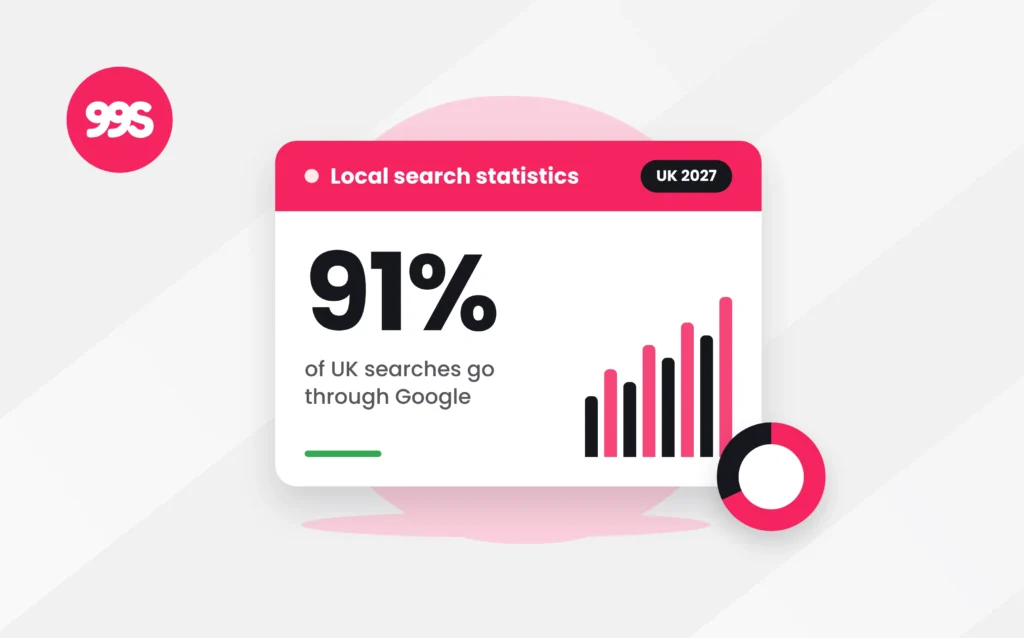
- 91% of UK search traffic goes through Google.
- 69.5% of UK Google searches end without a click, the highest of six countries measured.
- 89% of UK adults use online reviews when researching a purchase.
- 47% of consumers will not use a business with fewer than 20 reviews.
- 36.7% of UK consumers used AI to find a local business in the last month.
- Fake reviews have been illegal in the UK since April 2025.
How the UK searches
Source: Statcounter, June 2026. Share of search traffic, all devices.
of UK search traffic goes through Google, with Bing second on 6.22%.
What this means: For a local business, 'search' means Google. Get your Google Business Profile right before anything else.
Source: Statcounter, Search engine market share United Kingdom, Jun 2026 #
of UK online adults use Google Search every month, making about 3 billion searches.
What this means: Almost every customer you have uses Google. When they look you up, make sure what they find is current.
Source: Ofcom, Online Nation 2025, Dec 2025 #
of all general search queries in the UK are handled by Google, according to the competition regulator.
What this means: Google's position is so strong the CMA now regulates it. That is not changing soon.
Source: CMA, Google Strategic Market Status decision, reported by Whito, Oct 2025 #
was spent on Google search ads in 2024 by more than 200,000 UK businesses.
What this means: Plenty of your competitors pay for Google ads. A strong free profile and good reviews help you compete without the spend.
Source: CMA, Google Strategic Market Status decision, reported by Whito, Oct 2025 #
of UK Google searches end without a click to any website, the highest rate of six countries measured.
What this means: Most people get their answer on Google itself. Your Business Profile, reviews and photos often matter more than your website.
Source: SparkToro and Similarweb zero click study (UK), reported by Whito, Jun 2026 #
clicks to the open web for every 1,000 UK Google searches.
What this means: Fewer searches reach websites. Make sure the information Google shows about you is enough to win the call.
Source: SparkToro and Similarweb zero click study (UK), reported by Whito, Jun 2026 #
of searches now show an AI Overview at the top of the results.
What this means: AI summaries pull from reviews and listings. Accurate, detailed information helps you appear in them.
Source: Ofcom, Online Nation 2025, Dec 2025 #
of UK adults say they often see AI summaries at the top of Google results.
What this means: Half of searchers read the AI answer first. Being mentioned there is the new page one.
Source: Ofcom, Online Nation 2025, Dec 2025 #
is when Google launched AI Mode in the UK, a chat style search tab for longer, more complex questions.
What this means: People can now ask Google full questions like 'who is a reliable plumber near me who does weekends'. Make sure your profile answers them.
Source: Google, Introducing AI Mode in the UK, Jul 2025 #
How people find a local business
Source: Constant Contact, Small Business Now Q2 2026 (UK figures).
of UK consumers check reviews and ratings first when vetting a business online, ahead of pricing (20.5%), proximity (16.7%) and opening hours (10.6%).
What this means: Reviews are the first thing people look at. Prices and hours come next, so keep them up to date on your profile.
Source: Constant Contact, Small Business Now Q2 2026 (UK figures), 2026 #
of consumers start their search for a local business on Google, 52% on Google Search and 9% on Google Maps.
What this means: This is US data, but UK habits are similar. Google is where most local searches begin.
Source: BrightLocal, Small Business Marketing Report 2026 (US businesses), Oct 2026 #
of small business owners believe most of their customers come from Google, and they rank it only fifth among their channels.
What this means: Many owners underestimate Google. If you have not looked at your Business Profile lately, you are probably not alone.
Source: BrightLocal, Small Business Marketing Report 2026 (US businesses), Oct 2026 #
of consumers use more than one channel when searching for a local business.
What this means: People check Google, then social media, then reviews. Being consistent everywhere builds trust.
Source: BrightLocal, Consumer Search Behavior 2026 (US consumers), 2026 #
of local searches start on a mobile phone.
What this means: Most people look you up on their phone. Make it easy to call, message or get directions in one tap.
Source: BrightLocal, Consumer Search Behavior 2026 (US consumers), 2026 #
of consumers look at three or fewer businesses before deciding. Only 1% look at more than ten.
What this means: If you are not in the first few results, you are often not considered at all.
Source: BrightLocal, Consumer Search Behavior 2026 (US consumers), 2026 #
of consumers decide which business to use in under five minutes, and 75% in under 30 minutes.
What this means: Decisions are fast. Reply to calls and messages quickly or the customer will move on.
Source: BrightLocal, Consumer Search Behavior 2026 (US consumers), 2026 #
of consumers always or often add 'near me' to local searches (2025 survey).
What this means: Location matters. Make sure your address, service area and map pin are correct.
Source: BrightLocal, Consumer Search Behavior 2026 (US consumers), 2026 #
say clear, complete information is the top reason they choose which business to contact, ahead of reviews (30%) and clear pricing (29%).
What this means: A complete profile wins enquiries. Fill in every section, including services, prices and photos.
Source: BrightLocal, Consumer Search Behavior 2026 (US consumers), 2026 #
more clicks for businesses with complete Google Business Profiles, according to Google.
What this means: Completing your profile is the easiest win in local marketing, and it is free.
Source: Google figures, reported by Whitespark, 2025 #
Reviews and ratings
Share of consumers who will only use businesses at or above each rating. Source: BrightLocal, 2026 (US consumers).
of UK adults use online reviews when researching a product or service.
What this means: Nearly everyone checks reviews. A business with few or old reviews looks risky.
Source: Which? and CMA figures, reported by Whito, Mar 2026 #
of UK consumer spending each year may be influenced by online reviews, according to the CMA.
What this means: Reviews move real money. Asking every happy customer for one is worth the effort.
Source: Which? and CMA figures, reported by Whito, Mar 2026 #
of UK consumers check at least one review site before buying, rising to 91% of 18 to 34 year olds.
What this means: Younger customers check reviews almost every time. Make sure your profile has plenty of recent ones.
Source: Feefo and Censuswide, The Trust Advantage 2026 (3,000 UK consumers), 2026 #
of UK consumers are concerned about fake reviews, and 80% think fake reviews damage a brand's reputation.
What this means: Real, detailed reviews from named customers are more convincing than a wall of five stars.
Source: Feefo and Censuswide survey of 3,000 UK consumers, Jul 2026 #
of consumers will only use a business with four stars or more, up from 55% a year earlier.
What this means: Expectations are rising. Reply to every negative review and fix the cause where you can.
Source: BrightLocal, Local Consumer Review Survey 2026 (US consumers), Feb 2026 #
will only use a business with 4.5 stars or more, up from 17%.
What this means: Nearly a third of customers want 4.5 stars plus. Every review counts.
Source: BrightLocal, Local Consumer Review Survey 2026 (US consumers), Feb 2026 #
of consumers will not use a business with fewer than 20 reviews, and 47% of small businesses have fewer than 20.
What this means: Twenty reviews is a common threshold. If you are below it, make collecting reviews a priority.
Source: BrightLocal, Small Business Marketing Report 2026 (US businesses), Oct 2026 #
of consumers look for reviews from the last two weeks, up from 20%.
What this means: Old reviews count for little. Aim for a steady trickle of new reviews every month.
Source: BrightLocal, Local Consumer Review Survey 2026 (US consumers), Feb 2026 #
are likely to use a business that responds to all its reviews.
What this means: Replying to reviews, good and bad, shows there is a real person behind the business.
Source: BrightLocal, Local Consumer Review Survey 2026 (US consumers), Feb 2026 #
expect a reply to their review on the same day, up from 6%.
What this means: Check your reviews daily. A quick reply to a complaint can turn it around.
Source: BrightLocal, Local Consumer Review Survey 2026 (US consumers), Feb 2026 #
are put off by templated or generic replies to reviews.
What this means: Write a short, personal reply each time. Copy and paste answers look careless.
Source: BrightLocal, Local Consumer Review Survey 2026 (US consumers), Feb 2026 #
of consumers were asked to write a review in the last year, and 28% will always write one if asked.
What this means: Most people will leave a review if you ask. Send a link straight after the job or sale.
Source: BrightLocal, Local Consumer Review Survey 2026 (US consumers), Feb 2026 #
AI and local search
Using AI tools for local search
More than a third of UK consumers used tools like ChatGPT or Gemini to find a local business in the past month, and 75% of them are using AI for this more than a year ago.
Source: Yext, June 2026 (600 UK consumers).
of UK consumers used AI tools for local search in the past month.
What this means: AI is already part of how people find local businesses in the UK. Clear, accurate information everywhere helps AI recommend you.
Source: Yext, 2026 Consumer Search Behaviours (600 UK consumers), Jun 2026 #
of UK consumers who use AI for local search are using it more than a year ago, and 48% much more.
What this means: This is growing fast. Businesses that are easy for AI to understand will get more recommendations.
Source: Yext, 2026 Consumer Search Behaviours (600 UK consumers), Jun 2026 #
of UK consumers have tried a new local business because an AI tool recommended it.
What this means: AI is already sending customers to local businesses. Reviews and complete profiles are what it draws on.
Source: Yext, 2026 Consumer Search Behaviours (600 UK consumers), Jun 2026 #
of UK AI users rate their trust in AI recommendations for local businesses at 4 or 5 out of 5.
What this means: People trust what AI tells them. Make sure what it says about you is right.
Source: Yext, 2026 Consumer Search Behaviours (600 UK consumers), Jun 2026 #
of UK consumers check an AI recommendation on Google or Bing, and 43% visit the business's website.
What this means: AI starts the search, Google and your website close it. You need all three to be in good shape.
Source: Yext, 2026 Consumer Search Behaviours (600 UK consumers), Jun 2026 #
largest search service in the UK is now ChatGPT, according to Ofcom.
What this means: ChatGPT is a real search channel. Ask it about your business and your area to see what it says.
Source: Ofcom, Online Nation 2025, Dec 2025 #
of small businesses say they are working on their visibility in AI search.
What this means: This is US data, but your competitors are thinking about AI search too. Reviews and listings are the place to start.
Source: BrightLocal, Small Business Marketing Report 2026 (US businesses), Oct 2026 #
Want to be found wherever customers look?
We keep your social profiles active and up to date, so Google, AI tools and customers all see a business that is open and trusted. From £99 a month plus VAT.
Fake reviews and the law
is when fake reviews became a banned practice in the UK under the Digital Markets, Competition and Consumers Act.
What this means: Buying, writing or hiding reviews is now illegal. Never pay for reviews or ask staff and family to post them.
Source: UK Government, Fake reviews and sneaky hidden fees banned, Apr 2025 #
of global turnover is the maximum fine the CMA can now impose for breaking consumer law, including the fake reviews rules.
What this means: The penalties are serious. Only ever ask genuine customers for honest reviews.
Source: Which? and CMA figures, reported by Whito, Mar 2026 #
is when Google agreed with the CMA to put warning alerts on the profiles of businesses caught boosting their ratings with fake reviews.
What this means: Getting caught can mean a public warning on your Google profile. It is not worth the risk.
Source: Which? and CMA figures, reported by Whito, Mar 2026 #
UK businesses were placed under CMA investigation over their reviews in March 2026.
What this means: These are open investigations with no findings yet, but they show the CMA is enforcing the rules. Check how you collect and display reviews.
Source: Which? and CMA figures, reported by Whito, Mar 2026 #
of reviews in three product categories are likely to be fake, according to UK Government research from 2023.
What this means: Fake reviews are common, which is why genuine ones are worth so much.
Source: Which? and CMA figures, reported by Whito, Mar 2026 #
fake or policy breaking reviews were blocked by Google in 2024.
What this means: Google removes suspicious reviews. A sudden burst of five star reviews can get filtered out, so collect them steadily.
Source: BrightLocal, Local Consumer Review Survey 2026 (US consumers), Feb 2026 #
Sources and how we chose these stats
We only include figures from original research, government announcements, regulators and named surveys, or platform data reported by trade press. Where a survey is not UK only, we say so.
The biggest surveys of how people choose local businesses are run by BrightLocal in the US. We include them because UK habits are very similar, and every US figure is labelled as such. Where UK data exists, from Ofcom, the CMA, Yext, Feefo and Constant Contact, we use it first.
- Statcounter, Search engine market share United Kingdom, Jun 2026
- Ofcom, Online Nation 2025, Dec 2025
- CMA, Google Strategic Market Status decision, reported by Whito, Oct 2025
- SparkToro and Similarweb zero click study (UK), reported by Whito, Jun 2026
- Google, Introducing AI Mode in the UK, Jul 2025
- Constant Contact, Small Business Now Q2 2026 (UK figures), 2026
- BrightLocal, Small Business Marketing Report 2026 (US businesses), Oct 2026
- BrightLocal, Consumer Search Behavior 2026 (US consumers), 2026
- Google figures, reported by Whitespark, 2025
- Which? and CMA figures, reported by Whito, Mar 2026
- Feefo and Censuswide, The Trust Advantage 2026 (3,000 UK consumers), 2026
- Feefo and Censuswide survey of 3,000 UK consumers, Jul 2026
- BrightLocal, Local Consumer Review Survey 2026 (US consumers), Feb 2026
- Yext, 2026 Consumer Search Behaviours (600 UK consumers), Jun 2026
- UK Government, Fake reviews and sneaky hidden fees banned, Apr 2025
Search market share figures from Statcounter measure search traffic, not people. Zero click figures from SparkToro exclude the Google mobile app, where the rate is likely to be even higher.
Want help keeping your business visible and trusted online? See what our plans include or sign up in about five minutes. Or see how our Google Business Profile management works.
More UK statistics: UK social media statistics, UK TikTok statistics, UK Facebook statistics, UK Instagram statistics, UK LinkedIn statistics.
UK local search statistics FAQs
What share of UK searches go through Google?
Statcounter found 91.19% of UK search traffic went through Google in June 2026, with Bing second on 6.22%. The CMA says Google handles more than 90% of general search queries in the UK.
What percentage of UK Google searches end without a click?
SparkToro's analysis of Similarweb data found 69.5% of UK Google searches ended without a click to any website in early 2026, the highest of six countries measured.
How many UK consumers read online reviews?
89% of UK adults use online reviews when researching a product or service, according to Which? figures cited by the CMA. Feefo found 85% of UK consumers check at least one review site before buying.
How many reviews does a local business need?
BrightLocal found 47% of consumers will not use a business with fewer than 20 reviews, and 68% will only use businesses rated four stars or more.
Are people using AI to find local businesses?
Yes. Yext found 36.7% of UK consumers used AI tools for local search in the past month, and 24% have tried a new local business because of an AI recommendation.
Are fake reviews illegal in the UK?
Yes. Since 6 April 2025, fake reviews have been a banned practice under the Digital Markets, Competition and Consumers Act, with fines of up to 10% of global turnover.
Can I use these statistics?
Yes. Please quote the original source shown under each stat and link to this page. Each stat has its own link and a ready made citation.
How often is this page updated?
We update it at least once a year, as Ofcom, BrightLocal and the CMA publish new data.